Dot Grid vs Lined vs Plain Paper: Which Should You Use?
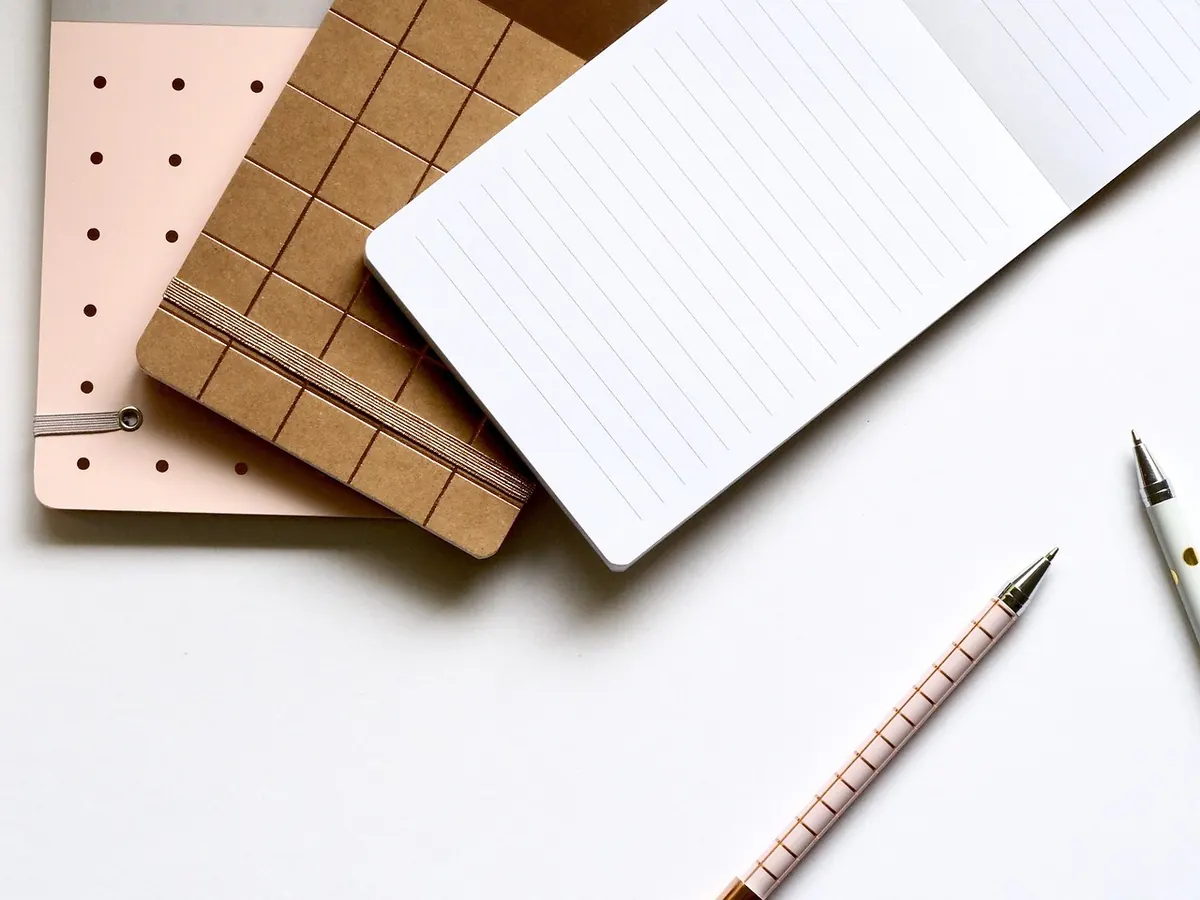
The paper shelf is a quiet trap. You go in for one notebook and come out with three, because the ruling — those lines, dots, or nothing at all — changes what the page wants you to do. A lined page invites sentences. A dot grid invites structure. A plain page invites anything, which is both its appeal and its problem. Choosing well comes down to what you write, how you write it, and how much patience you have for fighting your own notebook.
What a ruling actually does
Every ruling is a set of alignment cues. Lines give you a baseline and a steady rhythm. Dots give you a grid you can follow or ignore. Nothing gives you complete freedom and no help whatsoever. It helps to think in two axes: horizontal guidance keeps handwriting level and evenly spaced, while vertical guidance helps you line up columns, boxes and diagrams. Lined paper offers the first and almost none of the second. Dot grid offers both, faintly.
Dot grid: structure without the cage
Dot grid paper is printed with a regular field of small dots, usually spaced five millimetres apart, though four and seven millimetre versions exist. The dots are light enough to disappear beneath writing but present enough to guide it.
That balance is why bullet journals use it. Habit trackers, monthly logs, tables, charts and simple diagrams all line up neatly, and a spread can switch from prose to a boxed grid without looking untidy. You can also rule your own lines with a pen and ruler, then watch them fade into the background once the page is filled.
Where dot grid struggles
If your handwriting is large, five millimetre dots give you almost no usable baseline — they are a suggestion, not a rule. Dense paragraphs can look slightly adrift. Cheaply printed grids, where the dots are too dark or the spacing drifts across the page, are worse than no grid at all.
Lined paper: the default that earns its keep
Lined paper is the safest choice for anything that reads as writing. Ruling of roughly six to eight millimetres suits most adult handwriting with a fine or medium pen; wider ruling gives beginners and larger hands more room. Narrow ruling, around five millimetres, suits small, tight handwriting and fine nibs, but feels cramped with anything broader.
Long-form journalling, letters, meeting notes and manuscript drafting all sit comfortably on lines. The ruling does its job quietly: it keeps the page legible and makes it easy to see how much you have written at a glance.
Where lined paper struggles
The moment your notes need a diagram, a timeline or two columns, lines start working against you. Vertical alignment becomes guesswork, so tables wobble. Lined paper also has a psychological pull: it invites you to fill every line, which is fine for prose and less fine for sketchnotes that want breathing space.
Plain paper: freedom with a tax
Plain paper is the natural home of drawing. Life sketching, ink work, brush lettering, thumbnail layouts and mind maps all benefit from a surface that offers no opinion. Nothing competes with a wash or a looping capital.
The tax is drift. Without a baseline, most people’s handwriting slopes and wanders within a few lines, and margins become uneven. The standard fix costs nothing: slip a lined or dot grid sheet underneath and use it as a guide, provided the top sheet is thin enough to see through. Writing on a single sheet over a ruled pad works just as well. For lettering practice, a guide sheet with x-height, ascender and descender lines beats lined paper with the wrong spacing.
Matching the ruling to the job
- Long-form writing, journalling, letters: lined, seven to eight millimetres, or narrower if your handwriting is small.
- Bullet journals, planners, habit trackers: dot grid, five millimetres.
- Meeting and lecture notes: lined if they are mostly prose, dot grid if you sketch process flows alongside them.
- Drawing, inking, brush lettering: plain.
- Technical sketches, room layouts, scale plans: graph paper or dot grid, where the grid carries real information.
- Handwriting practice: lined, or a ruled sheet with vertical guides if you are working on slant and letter width.
If you keep one notebook for everything, dot grid is the compromise that upsets the fewest tasks. It writes almost as tidily as lined paper and draws almost as easily as plain.
The ruling is only half the story
Paper quality decides whether a page is a pleasure or a frustration, and it matters more than the pattern. Weight, coating and absorbency govern how ink behaves. A notebook with perfect dot spacing but thin, porous paper will bleed, feather and show every mark through the reverse side.
As a rough guide, paper around 80 to 90 gsm handles pencils, ballpoints and most rollerballs comfortably. Fountain pens, broad nibs, fineliners and markers generally want something heavier, or a coated sheet designed for wet ink. If you use a fountain pen, test the paper before buying three of the same notebook. Texture matters too: a slick sheet flatters a fine nib but makes pencil feel slippery, while a slightly toothy sheet grips graphite and gives more control.
The best ruling is the one you stop noticing halfway down the page.
Check the practical details as well: whether the ruling runs to the edge or stops at a margin, whether the pages lie flat, and whether the paper is cream or white. Cream is easier on the eye under lamplight; white gives more contrast for fine ink lines.
How to settle it for yourself
Buy one small notebook in each ruling — A5 or pocket size is plenty — and use them with the pen you actually carry. Give each a fortnight and notice which one you reach for without thinking. Most people find the answer is not the paper they admire but the paper they use.
- Keep a guide sheet tucked inside plain notebooks: lined underneath, plain on top.
- Test new paper with your wettest pen before committing to a stack.
- Match ruling width to handwriting size, not to fashion.
- If you mix prose and diagrams regularly, keep a dot grid notebook and a lined one rather than forcing one to do both.
Whichever you pick, buy a spare. Running out mid-project is the only paper problem with no workaround.
Photo: JessBaileyDesign / Pixabay